Design That Heals: Human-Centered Design in Behavioral Health
- Matthew Doty
- Aug 16, 2025
- 5 min read
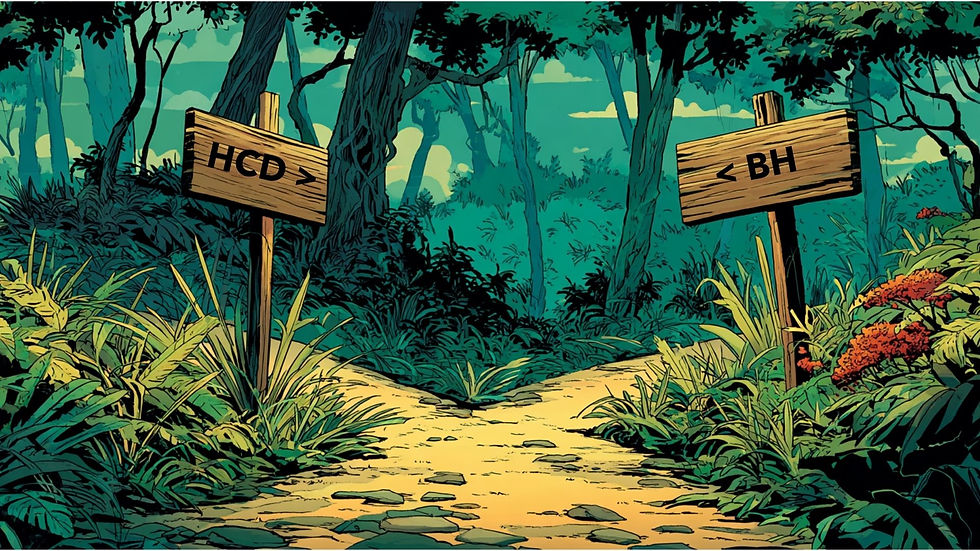
Behavioral health is not a straight path. It is more like a winding trail through dense, uneven terrain. Some stretches feel calm and clear. Others are steep, disorienting, and full of obstacles you do not see coming.
In this kind of landscape, design is not about handing someone a map and wishing them luck. It is about walking the path with them. It is about building trails that are safe, navigable, and respectful of the people making the journey. That is where human-centered design comes in.
Human-Centered Design as Essential Gear

In other industries, human-centered design (HCD) might help you find a faster route or make the trip more comfortable. In behavioral health, it is survival gear. At its core, HCD asks:
Who is on this journey?
What do they truly need to keep moving forward?
How do we shape the environment so the journey supports them instead of wearing them down?
These questions cut through the noise of policy language, compliance requirements, and operational bottlenecks. They bring the focus back to the people, clients, families, and providers, and keep it there.
The Journey Is Multichannel

Behavioral health experiences are not delivered in one place or through one medium. They are the culmination of a connected network of touchpoints that shape the end-to-end care journey. Think of it as a series of trail segments that must link together smoothly.
Intentionally design harmony across:
Products: Tools, kits, and resources are like the gear you hand to someone before they head out. They can inspire confidence or cause frustration before the first step is taken.
Services: Every human interaction, from the first intake call to a late-night crisis conversation, is a checkpoint that either reassures or rattles the traveler.
Physical spaces: Waiting rooms, therapy offices, and community centers are the clearings along the route. They can offer rest and safety or make someone want to turn back.
Technologies: Apps, portals, telehealth, and AI tools are the bridges and shortcuts that can open up access, but only if they feel secure, intuitive, and connected to the rest of the path.
When these elements are designed in isolation, the journey becomes disjointed. A safe and welcoming clinic might lead to a confusing portal. A great app can be undermined by a tense front desk exchange. The real opportunity is in designing the harmony so each step naturally leads to the next.
Why It Matters Most Here

When done well, behavioral health organizations that understand and embrace human-centered design will see real progress toward:
Removing barriers: Design remote care and in-person spaces as one connected route so no part of the journey is a dead end.
Building trust: Make sure tone, clarity, and respect feel consistent whether someone is logging in, walking through the door, or speaking to a counselor.
Preparing for crisis moments: In behavioral health, the most critical moments are often unexpected. The journey needs to be ready for those detours.
Supporting the supporters: Clinicians and staff deserve well-designed tools and processes so they can focus on care, not on wrestling with systems.
It Does Not Have to Be Impossible or Expensive

The journey forward does not require carving entirely new paths from day one. Often, the most meaningful progress starts with small, thoughtful steps.
Consider a hospital tackling psychiatric boarding for youths, a situation that often leads to frustration for families, strain on staff, and suboptimal care. One institution used human-centered design to reimagine this experience, responding to reports of insufficient training and inadequate environments. The result was real improvements in how youth are cared for during transitions out of the emergency department or inpatient units, achieved without major capital expense. The team prioritized listening to clinicians, caregivers, and youth to shape the redesign in both process and physical environment. (Source: Hospital Pediatrics, “Human-Centered Design to Improve Care for Youths Boarding for Psychiatric Emergencies” — https://publications.aap.org/hospitalpediatrics/article/14/5/394/197077/Human-Centered-Design-to-Improve-Care-for-Youths)
This demonstrates that when you begin with empathy, observation, and iteration rather than assumptions or budgets, you can create immediate value and build momentum. Small, user-centered fixes, especially when co-designed with those most affected, can pave the way toward broader transformation.
The Positive Financial and Operational Impact

Human-centered design is not just better for people. When done well, it pays real dividends in operational efficiency and financial sustainability.
Consider the following examples:
Toronto outpatient mental health clinic - waiting experience redesign: Faced with long waits and rising client frustration, a Toronto outpatient mental health clinic worked directly with clients and providers to reimagine the waiting experience. The team co-designed a simple in-waiting-room whiteboard showing the current queue status and average wait times. What changed: clients reported lower anxiety, patient flow improved, staff morale rose, and the concept scaled as a digital board to other clinics. (Source: BMJ Open Quality — https://bmjopenquality.bmj.com/content/12/1/e001781)
Johns Hopkins Health System - capacity dashboard for surge management: When COVID-19 put extraordinary strain on hospital capacity, Johns Hopkins brought administrators and front-line staff into the design process for an interactive capacity-management dashboard. By blending real-time data with predictive analytics and designing the interface with direct user feedback, leaders gained a practical tool for transparent, timely decisions. What changed: faster and more confident bed and staffing decisions during peak demand, clearer shared awareness across teams, and smoother allocation of resources. (Source: arXiv preprint — https://arxiv.org/abs/2403.15634)
Both of these examples share the same pattern:
Start small with a clear, meaningful improvement
Bring in the people who live the problem every day
Build and iterate in real settings before scaling
The return is twofold. You get immediate operational gains and a culture that is primed for continuous improvement. Because solutions are shaped by those who use them, they stick, scale, and deliver value far beyond the first implementation.
How It Comes Together

Technology can guide the trail, but empathy needs to lead it. Human-centered design is the compass that ensures every product, service, space, and workflow aligns with real people in real context.
Design "with" people, not just "for" them. Let these principles guide how you shape the journey.
Engage clients, families, and providers in shaping the path
Map journeys with emotional, physical, and environmental awareness
Prototype harmoniously linked touchpoints instead of isolated moments
Design for “edge cases” as real travelers, not outliers
Align protocols, products, and technologies so transitions feel natural
My Commitment and Your Opportunity

Recently, I decided to focus my 15+ years of design leadership on this vital intersection of behavioral health and human-centered design. I am actively looking to join an organization that shares this vision and is ready to transform care by designing whole-journey experiences that work for everyone.
If you are looking for leadership that blends vision, empathy, clinical rigor, and operational savvy, reach out to me. I can help you build the next segment of the trail, step by step, unlocking both human and financial returns along the way. Let’s connect and make that journey together.